As the 2022 midterms approach, fundraising for congressional races is starting to ramp up. All members of Congress filed their final campaign finance documents of 2021 last week, which detailed their fundraising and expenditures between October 1 and December 31, 2021.
Here are some key numbers to know, based on an Issue One review of these new filings.
$1.5 million
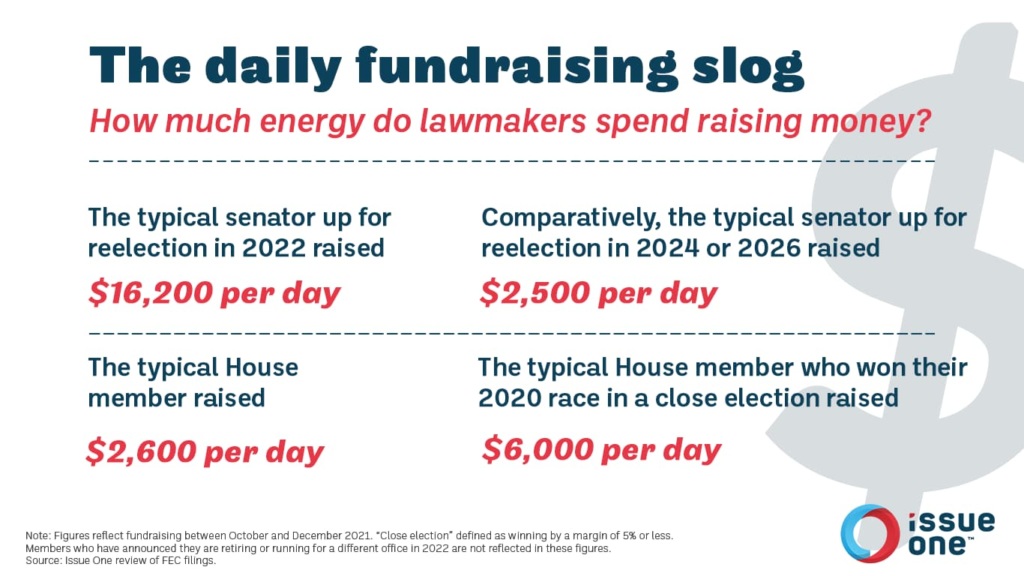
The median amount of money raised during the fourth quarter of 2021 by a sitting senator running for reelection in 2022 was $1.5 million — the equivalent of about $16,200 per day. That’s more than six and a half times as much money as their colleagues who are not facing reelection this election cycle, who typically raised $227,000 between October and December — about $2,500 per day.
$96.8 million
Combined, all incumbent senators raised $96.8 million from individuals, political action committees, and other sources between October and December. That’s roughly 1.5 times as much as all incumbent senators raised during the same time period two years ago. In total, during all of 2021, incumbent senators raised more than $382 million for their reelection campaigns.
$235,000
The median amount of money raised between October and December by a member of the House of Representatives running for reelection in 2022 was $235,000 — or about $2,600 per day. The median amount raised by a freshman House member was $294,000 — or about $3,200 per day. The typical House incumbent running for reelection in a race they won by 5 percentage points or less in 2020 raised roughly $550,000 during the fourth quarter — about $6,000 per day, or more than twice as much money as the typical House member.
$154 million
Combined, all House members raised $154 million from individuals, political action committees, and other sources between October and December. That’s nearly 20% more than all House members raised during the same time period two years ago. In total, during 2021, House members raised a total of about $586 million for their reelection campaigns.
93%
93% of members of Congress — including 92% of House members and all but two senators — have leadership PACs, political action committees that operate in addition to lawmakers’ official campaign committees. These PACs are often criticized by liberals and conservatives alike as slush funds. Created in the late 1970s as a way for members of Congress to raise extra money to give away to fellow politicians, leadership PACs open the door to corruption in two ways: Their funding often comes from special interest groups with business before Congress, and some politicians use them to fund lavish lifestyles, often under the guise of fundraising.
$102 million
Members of Congress raised $102 million for their leadership PACs during 2021. The typical lawmaker with a leadership PAC raised roughly $72,700 for their leadership PAC last year. But 11 lawmakers, most of whom hold high-ranking positions in Congress, raised over $1 million. The top-raising leadership PAC belongs to House Speaker Nancy Pelosi (D-CA), whose PAC raised a staggering $8.4 million during 2021. At $4.7 million raised in 2021, the second highest-raising leadership PAC was the House Freedom Fund, which is controlled by the leadership of the conservative House Freedom Caucus. Rounding out the top five highest-raising leadership PACs are: House Minority Leader Kevin McCarthy (R-CA), whose PAC raised $3 million; House Majority Leader Steny Hoyer (D-MD), whose PAC raised $2.6 million; and Rep. Adam Kinzinger (R-IL), whose two leadership PACs combined to raise $2.6 million.