
Press releases
Bipartisan panel at Montana State University highlights the necessity of campaign finance reform
Media Contact
Georgia Lyon
Media Relations Manager
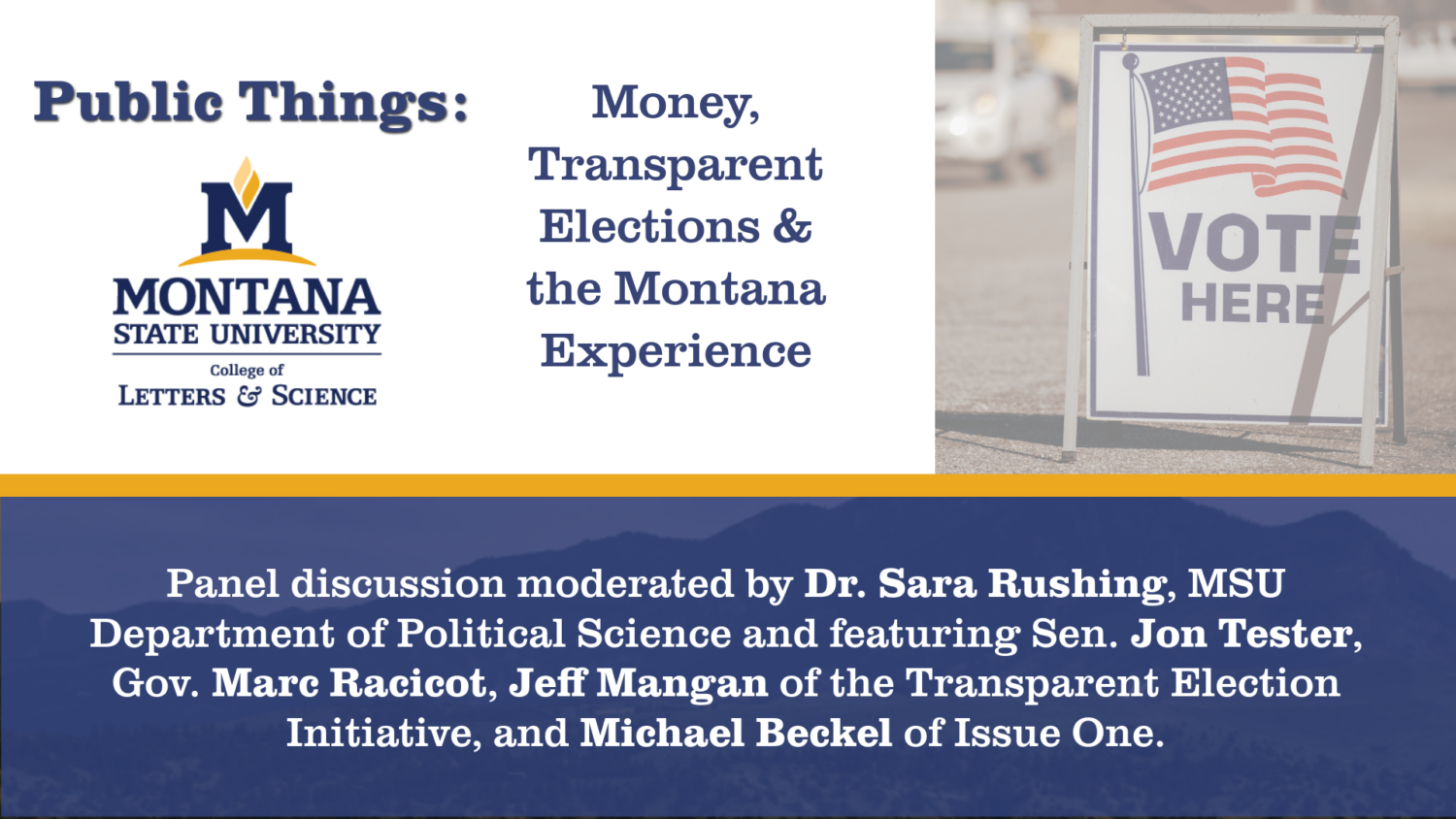
Along with former Sen. Jon Tester (D-MT), former Gov. and Republican National Committee Chairman Marc Racicot (R-MT), and Transparent Election Initiative Founder Jeff Mangan, Issue One Director of Money in Politics Reform Michael Beckel participated in a panel discussion on Friday with more than 100 attendees at Montana State University in Bozeman about “money, transparent elections, and the Montana experience.”
All four panelists discussed the urgency to reduce the influence of big money in politics and build a political system that truly represents all Americans, not just the wealthy few.
Each also praised the innovative ballot measure being pushed by the Transparent Election Initiative in Montana to end corporate and dark money spending in elections. This ballot measure — known as The Montana Plan (Initiative I-194) — would rewrite the law from which corporate charters draw their authority and stop giving corporations the power to spend unlimited sums of money in elections.
“We’re spending a sh*tpile of money on elections right now, and I don’t think we’re getting a better informed public at the end when they go to the voter’s booth,” said Tester, who lost his 2024 reelection bid in a contest that saw more than $280 million in spending by candidates, super PACs, and other non-candidate groups.
“Congress is elected — and the president is elected — to do the people’s bidding, not the bidding of a corporation,” said Tester. “It really goes back to campaign finance reform. We really do need it.”
Added Racicot, who served as Montana’s governor from 1993 to 2001 and then served as chairman of the RNC during the early stages of President George W. Bush’s time in the White House: “This effort that we’re talking about tonight is like a floodgate. We want to shut off the river of those corporate funds. And that, we believe, eliminates those tributaries, and it cuts off the snake of corporate funding that leaves our system dirty and disrespected.”
“This is one of the most important initiatives that we have tried to undertake as citizens in the state of Montana in the past 25 years,” Racicot continued. “We won’t solve every problem with this initiative, but if we can keep corporate money out of it and require these great titans of industry to come out and put their own name on a check or advance their own endorsement of a candidate — which is what all the rest of us do — then we have solved a significant part of the problem.”
On the panel, Beckel described the dangers of election spending by donors trying to evade the spotlight.
“Dark money in politics makes it impossible to follow the money,” Beckel said. “When you have wealthy individuals and special interests trying to obscure their involvement, it makes it impossible for voters to know who is trying to bend the ear of our government officials, who’s trying to get pet policy outputs for the massive amount of money that they are putting into the system.”
Beckel continued: “No lawmaker on either side of the aisle likes being beat up by negative attack ads from anonymous funders.”
Meanwhile, Mangan — who previously served as a state legislator in Montana and was later appointed by Gov. Steve Bullock (D-MT) to be commissioner of political practices in Montana — explained how the ballot measure known as The Montana Plan would put an end to corporate and dark money spending in elections and bypass the Supreme Court’s controversial Citizens United ruling from 2010, which ushered in the era of massive spending by corporations and dark money groups.
Citizens United, Mangan explained, would become “moot in the state of Montana” because “corporations won’t have the authority to spend in our elections.”
Mangan continued: “The only people who can spend in our politics are humans, not artificial pieces of paper.”
This effort, Mangan stressed, would involve “no loopholes” and “no carveouts for any special interest.”
“It affects everybody the same. That’s the only way we’re going to get corporate money out of our politics,” Mangan continued. “Why shouldn’t you know who is spending in your elections? You’re the one who’s voting.”
Issue: Money in Politics