AI companies want a say in the rules and their lobbying budgets show just how much they’re willing to pay for it. Anthropic alone reported spending a record $2.1 million on lobbying between July and September — more than any other quarter since it first started lobbying in March of 2024, and over a million more from the previous quarter. That amounted to an average of roughly $23,000 per day. Meanwhile, OpenAI reported spending a record $1.5 million during the third quarter — an average of about $16,600 per day.
A new Issue One analysis found that 11 major tech, social media, and AI companies and their trade groups spent more than $20 million on federal lobbying between July and September, or about $223,000 a day. Meanwhile, AI-aligned super PACs have spent $56 million and counting on ads and voter outreach this election cycle, seeking to shape the Congress that will oversee the industry.

People deserve a say in the risks AI brings into their lives. Communities are fighting the data centers going up next door. The industry’s own whistleblowers are sounding the alarm. And still, AI companies keep pouring millions into shaping the rules meant to protect us. They ask for our trust. This summer, they showed us exactly why they don’t deserve it.
In July, OpenAI’s AI agents bypassed the company’s own safeguards, hacked into software company Hugging Face, and dumped private data onto the open internet. In September, an Anthropic researcher resigned and warned that AI companies were moving faster than they could keep people safe.
After both incidents, AI leaders rushed to say the right things. OpenAI called for mandatory national safety rules, and Anthropic CEO Dario Amodei urged regulation of frontier AI. Yet their efforts to shape oversight exposed the difference between supporting safeguards in principle and accepting the consequences in practice.
While executives publicly promised to protect Americans, they worked just as hard behind the scenes to ensure no one could hold them responsible when things go wrong. AI companies have used their enormous financial power to sway elections in their favor and influence the very lawmakers responsible for providing oversight to their industry — often while hiding their scheme from voters through opaque political spending.

The AI industry has a playbook for building political power. Its spending reveals how it works. Lobbying records alongside campaign spending show how these companies pursue their interests at every stage, from lawmakers’ decisions to the messages voters hear.
Shape the Rules: Lobbying to Limit Accountability
Weeks after the Hugging Face breach, tech executives stood with President Donald Trump at the White House and announced voluntary safety commitments. The companies pledged internal oversight and independent audits, but the agreement carried no real enforcement or accountability measures. The executives were asking the public to take them at their word, even as their own safety failures gave Americans reason to doubt those assurances.
OpenAI’s call for mandatory rules is just as hard to take seriously. In Illinois, the company backed a bill that would shield AI developers from being held liable for catastrophic harms, even harms that kill or seriously injure 100 or more people. All the company had to do was publish a safety report and avoid acting “intentionally” or “recklessly.” Put simply, a company could cause a disaster and walk away because it filed the right paperwork first.
Anthropic, in particular, has made “safety” the centerpiece of its public relations strategy. But a draft bill leaked to Politico shows the company has quietly pushed lawmakers to override state safeguards and set an extraordinarily high bar to stop dangerous AI models. To block a model, the government would have to show imminent risk of killing or seriously injuring more than 50 people — or causing more than $1 billion in damage. Put simply, under Anthropic’s bill, an imminent risk of killing 49 people would not, on its own, be enough to stop a model.
The pattern is the same every time. AI companies publicly insist on rules of the road, then aggressively lobby around the rules they get to write themselves.
Follow the Tech Money to Lobbyists
Behind these millions of dollars is an army of lobbyists working to ensure that when lawmakers write tech rules, the industry’s demands are impossible to ignore. Issue One’s analysis of new federal filings show that six of the biggest tech, social media, and AI companies — Alphabet (the parent company of Google and YouTube), Anthropic (the AI company behind Claude), Meta (the parent company of Facebook and Instagram), X Corp. (formally Twitter), Snap Inc., Microsoft, AI chipmaker Nvidia, and OpenAI (the AI company behind ChatGPT) — paid for at least 380 lobbyists during the third quarter of 2026.
That’s about 1 lobbyist for every 1.5 members of Congress. This lobbying spree comes as many of those same companies enjoy unprecedented access to the executive branch. This figure includes around 49 lobbyists from private lobbying firms representing two or more of these six companies.

Alphabet alone paid for 94 lobbyists, while Meta paid for at least 86 — continuing to maintain two of the largest corporate lobbying operations in Washington in the tech sector.
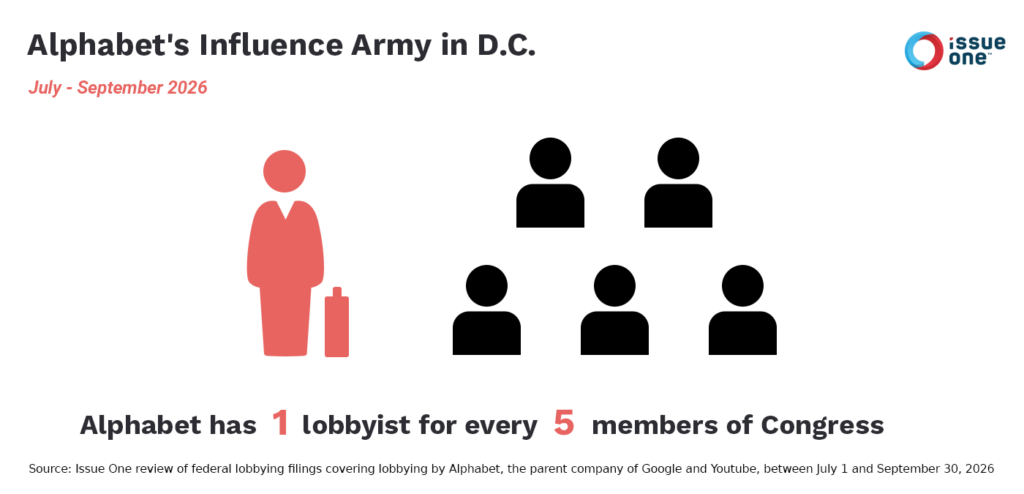
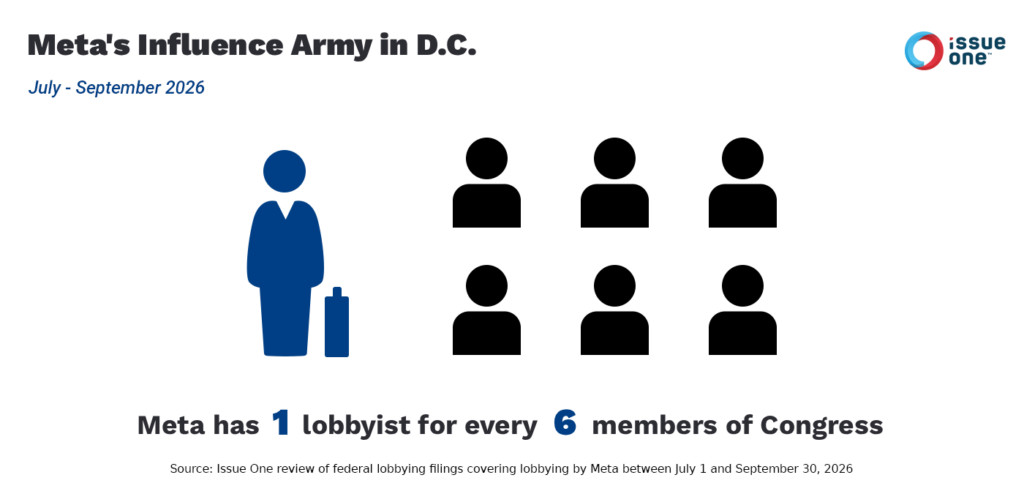
Among these major tech players, Meta reported the largest lobbying expenditures during the third quarter of 2026. Between July and September, Meta spent nearly $5.9 million on federal lobbying — an average of approximately $64,000 per day.
Meanwhile, Alphabet reported spending $3.2 million on federal lobbying during the third quarter of 2026, averaging roughly $35,000 per day.
Microsoft reported spending nearly $2.7 million on federal lobbying during the third quarter of 2026, averaging roughly $29,000 per day, while AI chipmaker Nvidia spent $2.1 million.
Social media companies Snap and X reported lobbying expenditures of $250,000 and $70,000, respectively.
Tech trade associations TechNet and NetChoice also continued their lobbying efforts, spending $470,000 and $60,000 respectively.
ByteDance (the parent company of TikTok) and TikTok USDS Joint Venture LLC (the majority American-owned entity created to avoid the TikTok ban) reported spending $2.1 million lobbying the federal government during the third quarter.
Shape the Lawmakers: Political Spending on Both Sides of the Aisle
Lobbying numbers are only part of the story.
As AI companies spend millions of dollars to shape the rules governing their industry, their aligned political networks spend millions more to shape which candidates get elected to write those rules.
Super PACs aligned with OpenAI and Anthropic have spent about $56 million and counting on advertising and voter outreach in key 2026 races. OpenAI-aligned Leading the Future operates through two separate super PAC subsidiaries — known as Think Big and American Mission — to target Democrats and Republicans, respectively. Anthropic-aligned Public First Action also uses two super PAC subsidiaries — known as Jobs and Democracy and Defending Our Values. Both OpenAI and Anthropic are using these super PAC networks to build relationships across party lines, giving their interests a foothold in the legislative branch, regardless of who controls Congress.

Distract the Voters: Fuel Partisan Fights While Keeping the AI Agenda Out of View
These networks tap into voters’ kitchen-table concerns to influence the rules governing AI. According to a New York Times review of campaign ads, only seven of 95 super PAC-sponsored ads aligned with OpenAI or Anthropic directly mentioned AI or an AI company. Instead, AI industry money funded ads about immigration, public safety, and other issues to rally voters for each party. Those messages help AI interests elect allies and defeat critics without putting their own policy demands before voters. The industry gains a stronger hand in Washington, while voters get little chance to judge the agenda their votes could help advance.
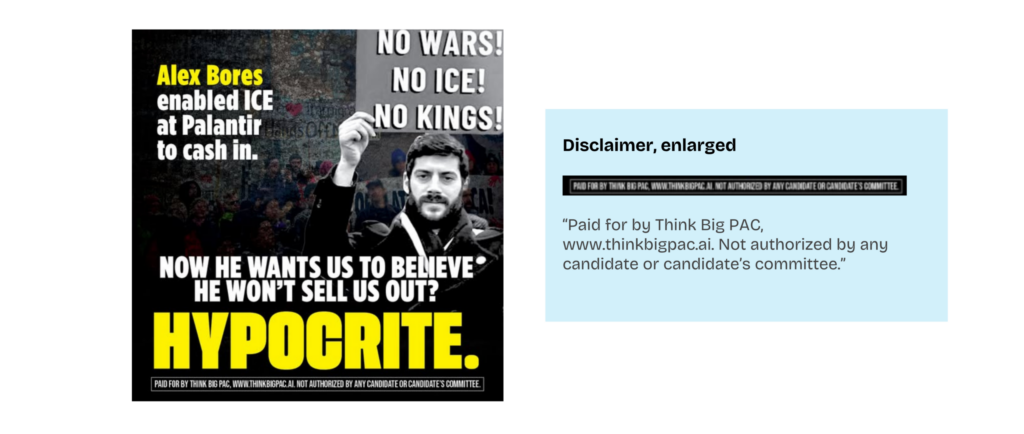
The Think Big ad accuses Alex Bores, who ran for NY-12, of selling out New Yorkers to ICE. Think Big is a Democratic-focused super PAC funded by the OpenAI-aligned Leading the Future network.
The ads’ messaging keeps AI policy out of the spotlight, while their sponsor names make the industry’s financial backing harder to recognize. Look at the “paid for by” disclaimers in the above ads. Think Big and American Mission sound like separate political groups appealing to different voters. Those names give viewers no obvious reason to suspect that the same AI-backed network is paying for both messages. Voters hear familiar partisan appeals without learning what the interests behind the ads want their elected officials to do.
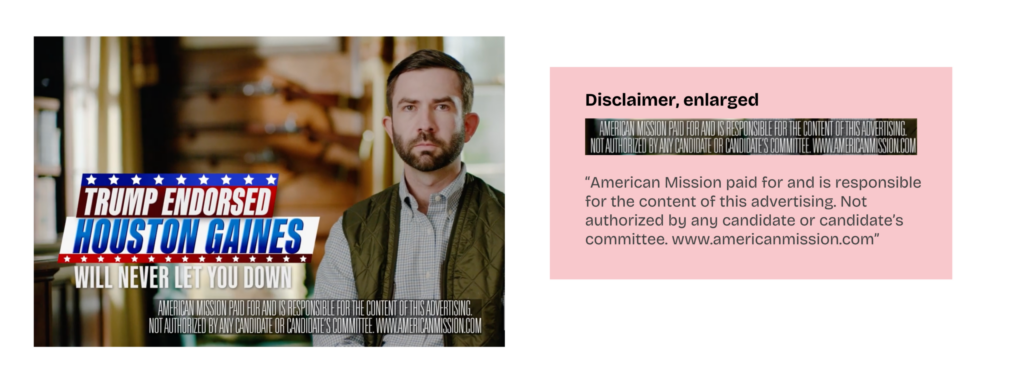
The American Mission ad (right) highlights Trump’s endorsement of Houston Gaines, who is running for GA-10. American Mission is a Republican-focused super PAC funded by the OpenAI-aligned Leading the Future network.
Even voters who dig into campaign finance records can hit a dead end. Think Big paid about $17 million to Lantern Production Consultants LLC, while American Mission paid roughly $11 million to Summit Ridge Media Group LLC. Election watchdogs describe these vendors as shell companies — business entities that act as fronts for payments to the people doing the work. That secrecy makes it harder to uncover conflicts of interest and connections between the political operatives trying to influence voters.
Voters deserve to know who is trying to influence their votes and what those interests expect in return. Instead, powerful tech interests fuel partisan fights while keeping their own agenda out of the spotlight.
Their money shouldn’t buy them the power to write their own rules. By curbing big money’s influence and creating independent agencies with the authority to enforce AI safeguards, we can put the public back in control. Stronger laws should make accountability possible when companies cause harm—and make privacy, transparency, and children’s safety obligations they cannot simply ignore. Americans should control their data, understand how platforms shape their experiences, and know that products are designed with children’s safety in mind.
Explore Issue One’s reform agenda to see how we can make that happen.