President Donald Trump’s second term in the White House has been defined by its repeated intervention on behalf of dominant technology firms, from picking winners and losers to shielding the industry from competition, accountability, and regulation.
“Big Tech and its lobbyists have taken Washington by storm since Trump was sworn in for his second term,” said Issue One Vice President of Advocacy Alix Fraser. “The Trump administration is packed with tech industry insiders who have acted in the interest of their own companies — not the American people — to rig policy for their own profit.”
Fraser continued: “Tech companies have unleashed pay-to-play politics at a scale rarely seen, running massive deceptive campaigns and deploying armies of lobbyists in order to evade accountability. Through these activities, tech companies have undermined U.S. national security and hindered commonsense protections for kids online at the state and federal levels. Congress must act to protect our children, defend American democracy, and finally hold Big Tech companies accountable for the harms they cause.”
Indeed, a new Issue One analysis of the latest federal lobbying disclosures shows that eight of the largest tech, artificial intelligence (AI), and social media companies spent a combined $71 million on federal lobbying last year alone — an average of nearly $330,000 per day that Congress was in session.

This total includes spending by:
- Alphabet, the parent company of Google and YouTube
- ByteDance, the parent company of TikTok
- Meta, the parent company of Facebook and Instagram
- Microsoft
- Nvidia, a leading designer of the computer chips powering the current AI boom
- OpenAI, the company behind the AI tool ChatGPT
- Snap, the parent company of SnapChat
- X, formerly known as Twitter
That spending paid off: Congress was sidelined while the White House pushed through policies that locked in industry advantages.
Among the tech sector’s biggest wins was Trump’s executive order in December that imposed a moratorium on AI regulation, despite roughly 80% of Americans supporting rules to ensure AI safety and data security, even if it slows development. The order blocks bipartisan state-level efforts to protect children online, prevent scams, curb algorithmic price fixing, and safeguard national security — all while favoring Big Tech’s bottom line.
The order also empowered David Sacks, the administration’s “crypto czar” and a major tech investor to organize a litigation task force to challenge state AI laws. Though he has divested from some high-profile holdings like Amazon, Meta, and Elon Musk’s xAI, filings show he and Craft Ventures still control more than 400 investments in AI-related tech companies who benefit from a moratorium.
Meanwhile, conservative frustration with the administration’s tech ties has been growing. Republican lawmakers, conservative think tanks, and commentators like Steve Bannon have criticized the administration for letting tech billionaires curry favor, pushing policies that enrich the industry while leaving everyday Americans without basic safeguards online.
Whose Lobbying Efforts Increased
Among these major tech players, Meta reported the largest lobbying expenditures in 2025, underscoring just how lucrative purchasing friends can be in Washington.
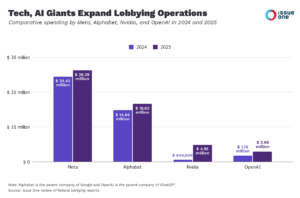
Last year alone, Meta spent a record $26.29 million on federal lobbying. This marks the most the company, whose CEO Mark Zuckerberg has aggressively sought access to the Trump White House to secure favorable policy outcomes, has spent on lobbying in a single year since it first hired federal lobbyists in 2009. And it represents a roughly 8% increase from what it spent in 2024. Overall, Meta hired 89 lobbyists in 2025 — roughly one for every six members of Congress.

Other major tech and AI players also increased their lobbying footprints in 2025:
- Alphabet spent $16.62 million — an increase of nearly 12% from 2024.
- Nvidia spent $4.95 million — nearly eight times the $640,000 it spent in 2024. Since the company’s resurgence in Washington in December 2022, it has now spent $6.19 million on federal lobbying and has landed several major policy wins.
- OpenAI spent $2.99 million — an increase of roughly 70% from 2024. Since OpenAI first hired federal lobbyists in November 2023, the company has now spent $5 million.
- Snap spent $1.02 million — an increase of 7% from 2024.
Whose Lobbying Efforts Decreased
Meanwhile, three major tech and social media companies either reduced or kept their lobbying expenditures the same in 2025 compared to 2024, though all still maintained extensive influence operations in Washington.
- Microsoft spent $10.1 million — 2% less than it spent in 2024.
- ByteDance spent $8.3 million — roughly 20% less than the record $10.4 million it spent in 2024.
- X spent $720,000 on lobbying — the same amount it spent in 2024.
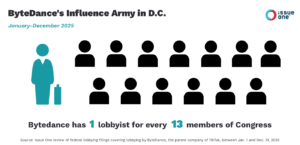
Despite its reduced spending, ByteDance employed an army of 42 lobbyists in Washington last year, or roughly one for every 13 members of Congress.
This presence comes as the Trump administration reversed course on its previous push to force TikTok to be divested from its Chinese ownership or be banned in the United States.
Since returning to the White House, Trump has signed five executive orders and brokered TikTok’s sale to a consortium of U.S. investors that includes Andreessen Horowitz, Oracle, Silver Lake, and Emirati-backed investment firm MG. The Trump administration has overtly disregarded bipartisan legislation to require divestment and a unanimous Supreme Court ruling — unilaterally delaying the statutory deadline to force a sale against the will of Congress, the American people, and the Supreme Court.