Mysterious donors are playing a major role in the 2026 midterms, and while Republicans are benefiting from more secret money, both parties are getting in on the action.
According to an Issue One analysis of newly filed campaign finance reports, the four main super PACs focused on helping Democrats and Republicans win House and Senate elections raised a combined $197.7 million from their affiliated dark money groups between January 2025 and June 2026.
During this time, the Republican-aligned Senate Leadership Fund (SLF PAC) and Congressional Leadership Fund (CLF), plus the Democrat-aligned Senate Majority PAC (SMP) and House Majority PAC (HMP), have raised $714.6 million combined.
Their four affiliated dark money groups – respectively known as One Nation, the American Action Network, Majority Forward, and House Majority Forward — account for more than $1 of every $4 these four super PACs have raised.
Republican-affiliated groups have abused secret contributions significantly more than Democrat-affiliated groups. The two Republican-aligned super PACs account for 58% of the total receipts and 58% of the money raised from affiliated dark money groups, while the two Democrat-aligned super PACs account for 42% of the total receipts and 42% of the receipts from affiliated dark money groups.
By law, super PACs are supposed to be political groups that disclose their donors. But the sad reality today is that both Republicans and Democrats are pumping huge amounts of money into opaque groups, leaving voters in the dark about which ultra-wealthy megadonors and special interests are trying to buy access and influence through large political contributions.
Our campaign finance system needs meaningful transparency for voters to be able to follow the money in politics. Anti-corruption guardrails don’t work when voters are kept in the dark about who’s bankrolling political ads. It’s long past time for members of Congress in both parties to tackle the tsunami of dark money polluting our politics.
Following the Dark Money
During the second quarter of 2026, the Republican-aligned Senate Leadership Fund and Congressional Leadership Fund each raised more than twice as much money from unknown contributors giving through their affiliated dark money groups donors than they did during the first quarter.
The Democrat-aligned Senate Majority PAC and House Majority PAC saw more modest increases in dark money funding.
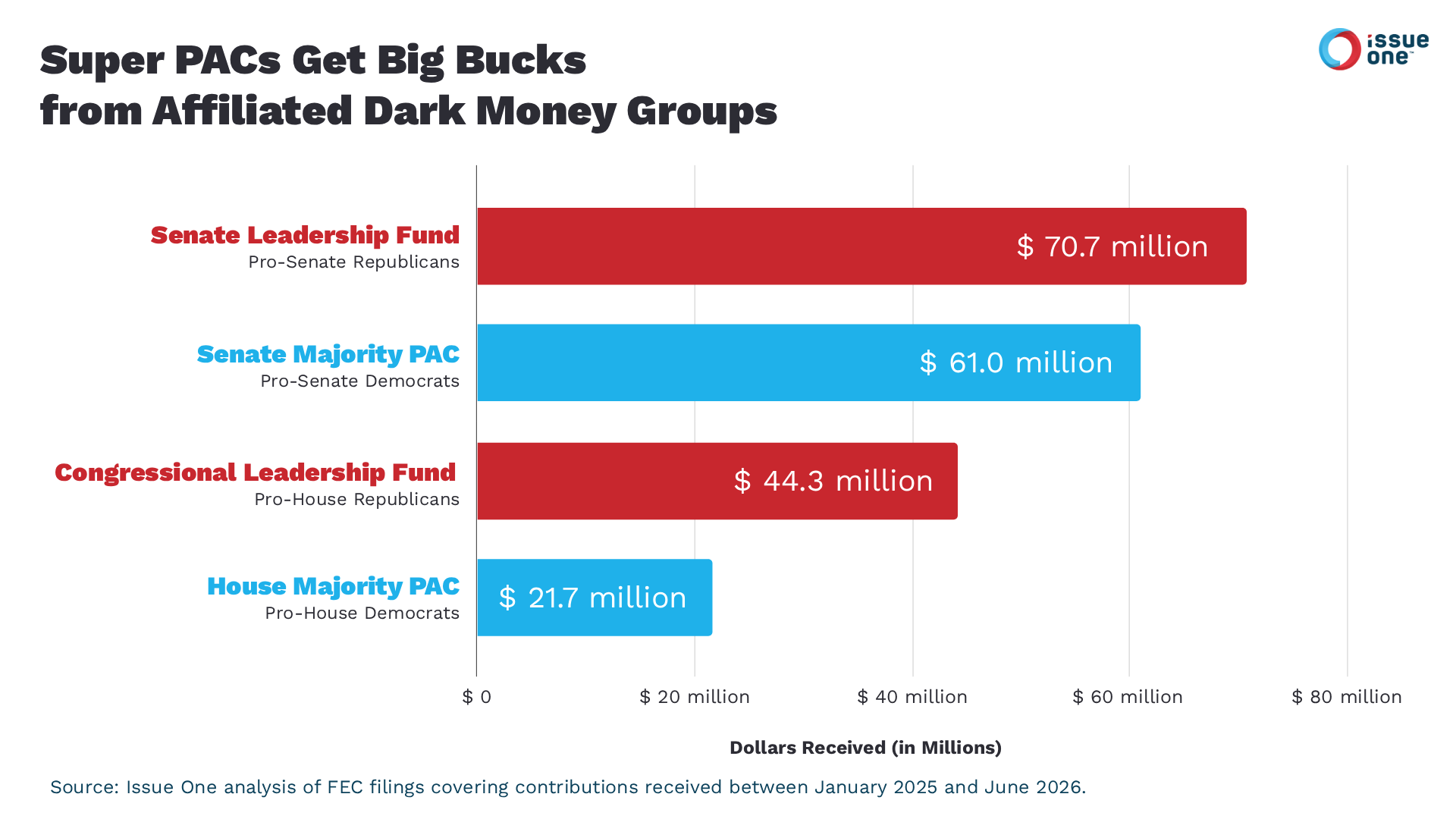
In June, the Republican-aligned, Senate-focused Senate Leadership Fund super PAC received $24.29 million from its affiliated dark money group, known as One Nation. That was more than double the $11.18 million it received from One Nation during the previous quarter.
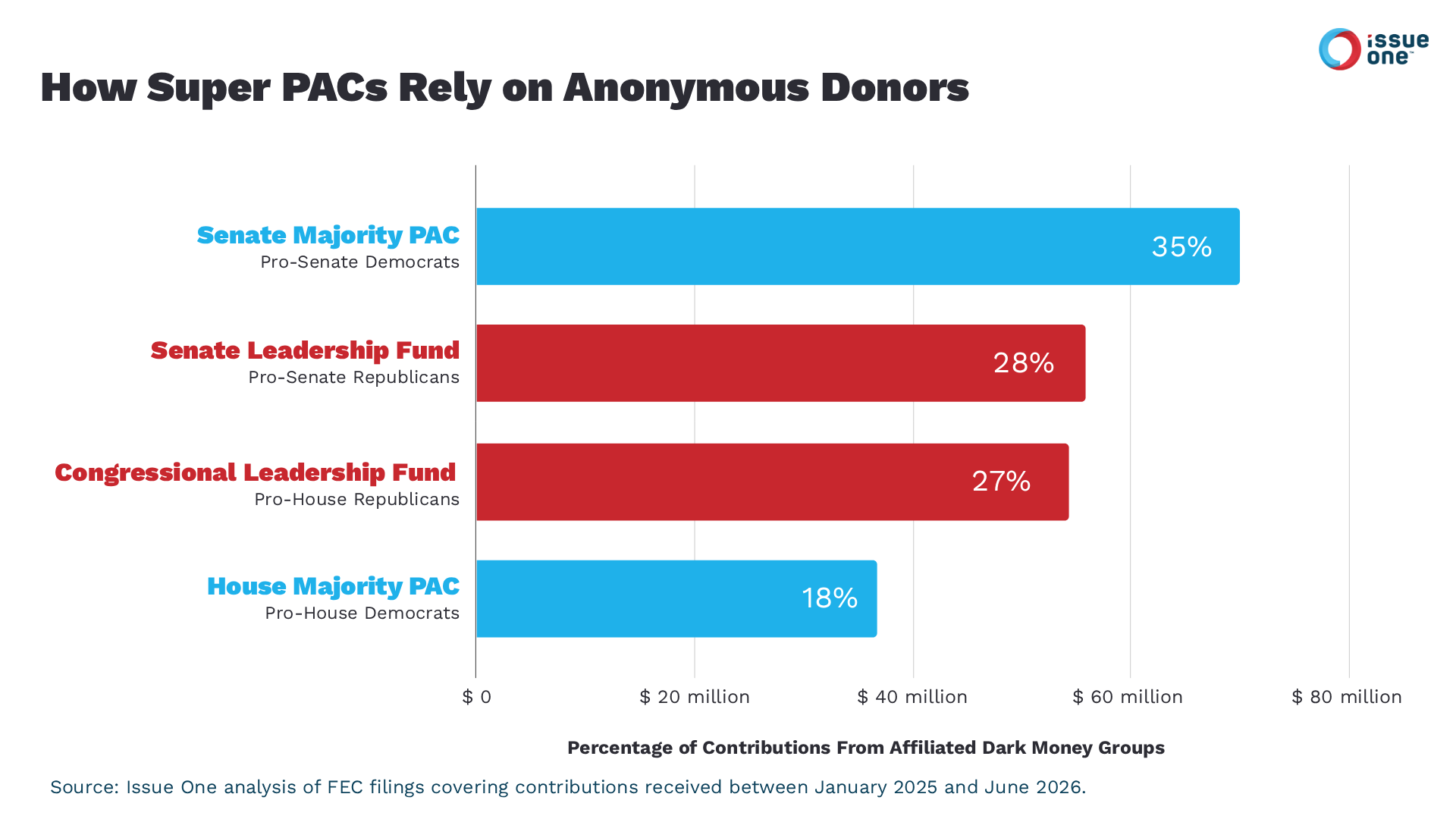
Since January 2025, the Senate Leadership Fund has now collected $70.74 million from One Nation — about 28% of its total receipts.
Similarly, the Republican-aligned, House-focused Congressional Leadership Fund super PAC received $20 million in June from its affiliated dark money group, known as the American Action Network. That was more than double the $7.5 million it received from the American Action Network during the previous quarter.
Since January 2025, the Congressional Leadership Fund has now collected $44.2 million from the American Action Network — about 27% of its total receipts.
Meanwhile, the Democratic-aligned, Senate-focused Senate Majority PAC super PAC received $28 million in June from its affiliated dark money group, known as Majority Forward. That was up just 12% from the $25 million it received from Majority Forward during the previous quarter.
Since January 2025, Senate Majority PAC has now collected $61 million from Majority Forward — about 35% of its total receipts.
And lastly, the Democratic-aligned, House-focused House Majority PAC super PAC received $6.5 million in June from its affiliated dark money group, known as House Majority Forward. That was up from the $4 million it received from House Majority Forward during the previous quarter.
Since January 2025, House Majority PAC has now collected $21.7 million from House Majority Forward — about 18% of its total receipts.
What Can Be Done to Illuminate and Combat Dark Money?
Since a pair of court rulings in 2010 — Citizens United v. Federal Election Commission and SpeechNow v. FEC — ushered in the dark money and super PAC era, Americans across the country have pushed for structural reforms to bring more transparency to the groups behind political ads.
For instance, voters in both deep-red Alaska and purple Arizona passed ballot measures that require actual disclosure of the true source of funds behind political ads, meaning donors trying to evade the limelight can no longer hide behind dark money groups, thanks to a structural fix.
The ballot measure passed by Arizonans also required political advertisers to identify their top three donors in a disclaimer within the ad itself.
And the ballot measure passed by Alaskans also required political advertisers to include a new disclaimer on political ads if they receive the majority of their funds from out-of-state donors.
These types of disclaimers ensure that groups with intentionally misleading names — including those that try to brand themselves as local efforts — give voters more cues to know if their funds are coming from out-of-state donors or billionaires like Michael Bloomberg or Elon Musk.
Additionally, this fall, voters in Montana will also be asked whether they want to end corporate and dark money spending in Montana elections through an innovative ballot initiative known as the Montana Plan.
The Montana Plan leverages the fact that states have the authority to define what powers corporations possess as artificial persons, and would rewrite the law from which corporate charters draw their authority and would stop giving corporations — including dark money groups — the power to spend unlimited sums of money in elections in the first place.