In a primetime address last month, President Trump used the power of the presidency to rehash tired, debunked claims about election interference and cast doubt on the security of America’s elections, while using those claims to justify greater federal control over a process the Constitution largely entrusts to the states. The speech captured the central concern facing the 2026 elections: the executive branch has become the most significant threat to the very safeguards designed to keep elections free and fair.
In May, we diagnosed America’s election safeguards as a resilient patient fighting off the virus of democratic backsliding. The system was not broken, but its immune system — the safeguards that protect elections from interference — was under immense strain. Historically, the federal executive branch has acted more like a vitamin, strengthening those safeguards. But in this administration, the executive branch has increasingly become the virus itself, attacking the system’s defenses from within.
Now, with Election Day just three months away, we’re taking the system’s temperature again. The prognosis is even more serious than before. The most concerning development is the further breakdown of internal checks within the executive branch that historically helped restrain presidential power to intervene in elections. Yet the election system’s immune system also held firm: election officials, courts, some state leaders, civil society, and voters continue to provide meaningful resistance, preventing the administration’s most sweeping efforts from taking hold. While the overall ratings have not changed, the safeguards have proven more resilient than many expected under sustained attack. The next three months will be the system’s most consequential test yet. Whether these safeguards hold will determine not only the health of the 2026 elections, but whether the damage can be contained before it becomes embedded in the system for future elections.
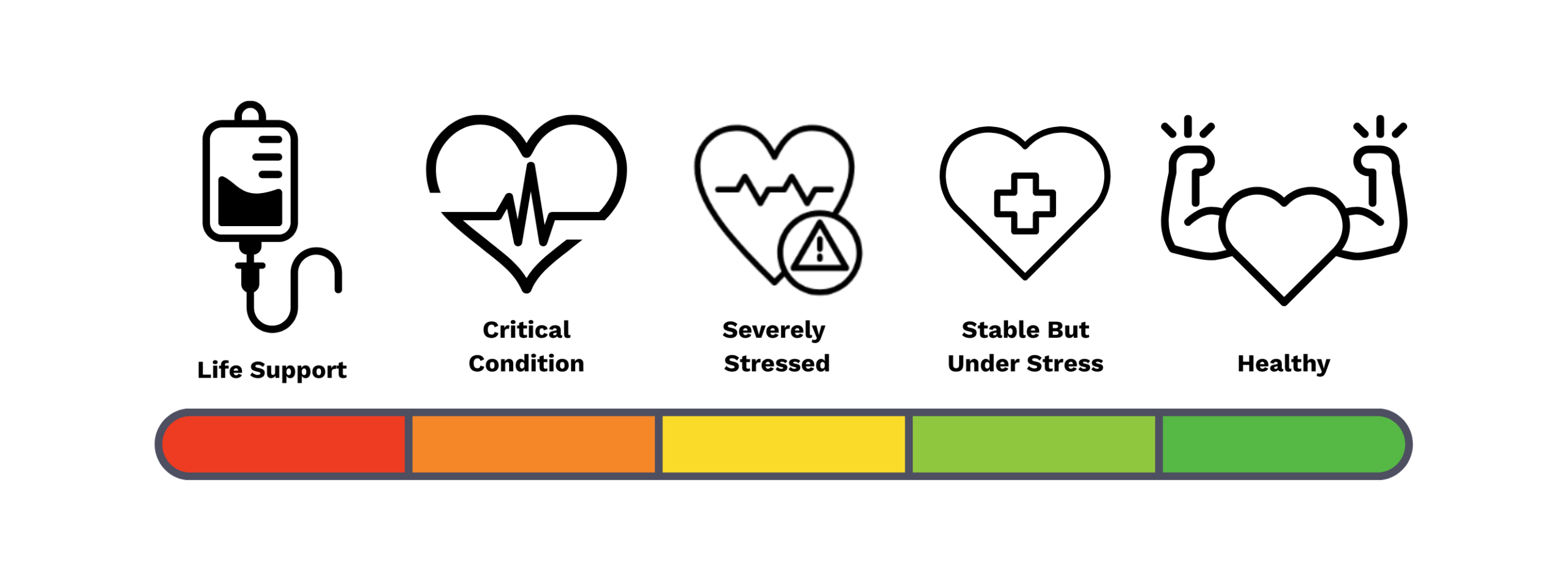
Here’s the state of the nine safeguards today:
- Congress: Critical condition
- Internal executive branch checks: Life support
- Election officials: Severely stressed
- State political leadership: Severely stressed
- Courts: Stable but under stress
- Law enforcement and military norms: Severely stressed
- Civil society: Severely stressed
- Information ecosystem: Critical condition
- Voters: Stable but under stress
 Congress – Critical Condition
Congress is a critical safeguard for elections: while states administer elections, the Constitution gives Congress authority over federal election rules and a constitutional role in checking executive overreach.
In many ways, Congress has ceded its constitutional role as a check on executive power, with most Republicans instead working to advance the White House’s election agenda and remaining silent as President Trump has continued his attempts to interfere in elections. House Speaker Mike Johnson has repeatedly sought to pass the SAVE America Act – a bill that would shift significant authority over elections from states to the executive branch by imposing new federal voter ID and documentary proof of citizenship requirements. In June, Rep. Anna Paulina Luna’s (R-FL) push to attach the SAVE America Act to the National Defense Authorization Act (NDAA) drew support from roughly a dozen hardline Republicans. This forced House leadership to send lawmakers home early ahead of the Fourth of July. Since then, Speaker Johnson has turned to the Reconciliation Bill 3.0 and the Stop Insider Trading Act, which the House has now passed, to try to enact key elements of the SAVE America Act through incentives and requirements tied to federal funding.
Resistance is growing louder, but still without meaningful Congressional defense of elections. Lawmakers who have been primaried by Trump-endorsed candidates, including Senator Bill Cassidy (R-LA) and Rep. Thomas Massie (R-KY), and retiring members including Senator Thom Tillis (R-NC) and Rep. Don Bacon (R-NE), have been among the most willing to break with the White House. Democrats, for their part, have shifted from objection to preservation: Senate Democrats, led by Schumer and Warner, are pressing the administration to retain all 2026 midterm election records, while Rep. Shontel Brown (D-OH) has demanded answers from the FBI over its raid on an Ohio voter-organizing group.
But these remain isolated acts of resistance. Without Republicans in Congress willing to stand up for elections and the Constitution, Congress remains a weak guardrail against executive overreach in elections.
 Internal Executive Branch Checks – Life Support
The most significant deterioration since our last health check has been the further erosion of the internal executive branch checks that once helped constrain presidential power over elections. Rather than serving as a safeguard against partisan interference, federal agencies are increasingly being used to advance the administration’s conspiracy theory-driven election agenda.
President Trump’s push for the SAVE America Act has become one of the clearest examples of this. While Congress has stalled on the legislation, the administration has continued to pursue the bill’s core provisions through executive action, public pressure, and threats against states and election officials that refuse to comply.
In President Trump’s July 16 primetime address, he repeated tired, false claims of Chinese interference during the 2020 election and used them to bolster his push for the SAVE America Act, despite intelligence assessments finding no evidence that China interfered with election processes. Trump’s remarks, coupled with comments from Trump’s personal lawyer that the president should declare a national emergency to seize control of elections, the FBI redirecting analysts to review documents from Fulton County’s 2020 election records, and the DOJ’s decisions to send election monitors to six states in November fit the broader pattern of politicized and targeted executive branch interference, particularly in blue states and cities.
One of the most direct attacks on election administration from inside the executive branch came in early July when Trump dismissed the three remaining members of the Election Administration Commission (EAC). The EAC is an independent federal agency that administers election funds and certifies voting systems, among other responsibilities. This move left the EAC without any commissioners just months before the midterms.
The administration has also continued to gut the Cybersecurity and Infrastructure Security Agency (CISA), with staff describing the agency as under-resourced and largely unable to act. In addition, CISA acknowledged that it has not done any “gap analysis” on the protection of election security infrastructure since October 2025, even though more than 1,000 employees were redirected to Immigration and Customs Enforcement and the agency suffered major staff layoffs and cuts. The Trump Administration has threatened to withhold funding for states’ cybersecurity, emergency planning, and training under FEMA unless they comply with the administration’s election agenda. DHS Secretary Mullin has said CISA election support would continue to be withheld unless states participate in the flawed SAVE program and increase federal oversight over voter rolls. This escalation is just another example of how the administration is leveraging internal agencies to bend states to harmful election priorities.
The erosion of internal checks and the continued amplification of election-deniers’ voices within the president’s administration are further weakening the safeguards against presidential overreach, placing greater pressure on courts, states, election officials, civil society, and voters to serve as the remaining lines of defense.
 Election Officials – Severely Stressed
Local election officials, regardless of party affiliation, remain among the strongest safeguards in America’s decentralized system of elections, but they are under growing, intense pressure.
On-the-record pushback from election officials, regardless of party, remains one of the strongest signals that this guardrail is bending but not breaking. When President Trump and his allies alleged fraud in California’s June primary, Secretary of State Shirley Weber publicly rejected the claim, stating plainly that “accuracy comes before speed” and that the state’s 30-day canvass window was state law in action, not evidence of manipulation.
But pressure from the executive branch on election officials has escalated sharply. On July 8, the Department of Justice (DOJ) sent letters to all 50 states and D.C., threatening to prosecute top election officials if any ballots cast by noncitizens were counted this cycle, despite noncitizen voting already being illegal and exceedingly rare. These letters come as President Trump and hardline Republicans in Congress continue to push the SAVE America Act forward, which would allow private lawsuits against election officials and impose criminal penalties. The DOJ also subpoenaed the Fulton County Board of Registration and Elections for personal information of thousands of employees and volunteers who worked on the 2020 elections–a request that a federal judge denied.
This pressure isn’t limited to letters and subpoenas. Many officials have not received additional resources from state or local governments to address federal cuts. In addition, the federal raids on election offices in Fulton County, Georgia, and Maricopa County, Arizona, as well as the seizure of ballots by Riverside County, California’s sheriff, have raised alarms that election officials might be subject to politically motivated investigations, a fear compounded by the ongoing spread of false election fraud narratives.
As threats and harassment against election officials have grown in recent years, the rate at which election officials leave their positions continues to increase. However, even under escalating pressure, election officials remain a critical safeguard for free and fair elections.
State Political Leadership: Governors and State Legislatures – Severely Stressed
In our nation’s decentralized election system, state political leadership remains an important check on executive branch overreach. However, the partisan divergence between states has continued to widen, producing sharply different levels of election protection across the country.
This primary season has produced a growing number of election deniers advancing to general election contests. For the secretary of state, governor, and attorney general races, a States United Action analysis found at least 53 election-denying candidates running across the country, including in battleground states like Arizona, Georgia, Wisconsin, Pennsylvania, and Nevada, with more primary elections still to come. If elected in November, many of these candidates would hold direct authority over election certification in their states, meaning this guardrail’s condition may hinge heavily on the outcome of the very election it’s meant to protect.
Iowa illustrates how high the stakes are. Governor Kim Reynolds, who will play a role in certifying the state’s 2026 election results, including competitive House and Senate races, declined in 2020 to join Iowa Attorney General Tom Miller’s effort opposing Texas’ attempt to overturn election results in other states, raising concerns about how she and other state leaders may respond when faced with partisan pressure after the 2026 elections.
Despite these troubling developments, bright spots still remain. Five Democratic-led states – California, Colorado, Connecticut, Maryland, and Washington – have enacted new shields against federal interference, including protections for late-arriving mail ballots and buffer zones keeping law enforcement away from polling places. A coalition of governors has written to the U.S. Postmaster General opposing a proposed rule change that would block eligible voters from participating in elections.
Also on the positive side, of the 30 states and D.C. that received DOJ demands for complete, unredacted voter rolls, five Republican-led states have pushed back against the Trump administration, citing their own constitutional authority and data privacy concerns. After New Jersey Governor Mikie Sherrill announced a software error that led to noncitizens being added to voter rolls under that state’s previous administration, leaders across the state took immediate steps to correct the issue and hold the vendor accountable.
While state political leadership can play a key role in deterring election subversion and maintaining voters’ trust in elections, this guardrail must be watched carefully, as pushback remains uneven across the country.
 Courts – Stable but Under Stress
Federal courts remain the strongest check on the administration’s election agenda, repeatedly affirming states’ constitutional authority over elections.
District courts have consistently rejected DOJ lawsuits seeking states’ unredacted voter rolls, leaving the administration 0-20 so far in these cases (as of Aug. 4), and it also lost its first appeal in Michigan. The courts declined to fast-track three other DOJ voter roll appeals.
A Massachusetts district judge voided portions of Trump’s second election executive order on mail voting, blocking DHS from compiling a list of all U.S. citizens and USPS from withholding mail ballots from voters not on an approved list in the plaintiff states. However, on July 27, the Administration filed an emergency appeal to the Supreme Court to implement the order. Separate rulings have blocked proposed USPS procedures to comply with the executive order, and another judge refused to dismiss a lawsuit against the “unconstitutional” order, setting the stage for legal challenges to proceed.
The Supreme Court delivered a rare, closely divided victory for election administration in Watson v. RNC, upholding states’ ability to count mail ballots that arrive after Election Day so long as they’re postmarked on time. Yet the underlying vulnerabilities identified six months ago remain. The Supreme Court’s Louisiana v. Callais ruling and the broad immunity for “official acts” committed by the president continue to pose troubling precedents.
At the lower court level, isolated rulings by judges have approved the seizure of election materials and allowed Republican states to continue using the SAVE data system despite privacy concerns while contradicting a previous court order. Such conduct raises concerns that these judges could be weaponized by the administration in the future. The courts remain a necessary safeguard, but their effectiveness ultimately depends on judges’ willingness to enforce constitutional limits and on meaningful compliance with their rulings.
Law Enforcement and Military Norms – Severely Stressed
The use of federal law enforcement in election-related activity has crossed into deeply concerning territory, threatening a longstanding norm that law enforcement and the military remain separate from partisan election disputes.
The FBI raided an Ohio office of the Ohio Organizing Collaborative, a group that supports voter registration work, seizing documents and computers as well as tracking down staff at their homes. The FBI also interviewed Milwaukee police officers over 2020 election rumors, fueling concerns that federal law enforcement will be weaponized for political purposes. This type of federal intervention into the work of a nonpartisan civic organization is not normal and has heightened fears of law enforcement powers being weaponized for political purposes.
The uncertainty extends to Election Day. DHS Secretary Markwayne Mullin said federal officers could appear at polling places in response to a specific threat, while two federal officers confronted a poll worker at a Syracuse, New York, polling station over a social media post. President Trump has continued to say he would do whatever is necessary to ensure honest elections when pressed on deploying ICE agents or the National Guard to polling places – keeping voters and election offices uncertain about the scenarios in which law enforcement could be deployed on Election Day.
Civil Society – Severely Stressed
Civil society organizations are facing escalating pressure as they continue to serve as a critical check on election interference.
The House Oversight Committee opened an investigation into a nonprofit; ICE and HHS agents made an unannounced visit seeking client records at an immigration nonprofit, and the FBI raided the Ohio Organizing Collaborative’s offices over voter registration records. This pattern suggests the administration is treating organizations supporting voters and democratic participation as an obstacle to its election takeover agenda.
Despite these pressures, civil society remains a vital and active safeguard. Nonpartisan groups, nonprofits, journalists, and community networks have won court cases, conducted voter outreach and education, and begun grassroots mobilization and organizing ahead of the general midterm elections. Broad coalitions and sustained coordination will be essential to ensure these networks can continue to serve as a check on election interference and to protect voters in the months leading up to the elections.
Information Ecosystem – Critical Condition
The information ecosystem remains one of the most at-risk safeguards protecting elections, with the Trump administration continuing its election takeover playbook of amplifying tired, debunked, false fraud narratives to justify efforts to interfere in elections and tilt the playing field.
During the primary season, voters have increasingly turned to AI tools as a substitute for traditional news coverage of voter guides, even as experts warn the tools remain unreliable and unverified. Security researchers have identified a wave of newly registered websites impersonating official voter information sites to spread false claims about candidates, alongside phishing campaigns linked to Russian-affiliated operations that clone legitimate media outlets’ branding and web design.
The Trump administration and election deniers have continued to peddle false narratives around noncitizen voting, absentee ballots, foreign interference, “rigged” elections, and counting of ballots. Despite research showing the accuracy of each state’s voter rolls, the Administration keeps uplifting false narratives to justify policy changes. In July, President Trump’s primetime address and DHS Secretary Markwayne Mullin’s subsequent briefing recycled familiar election falsehoods to bolster the administration’s push for greater executive branch control over elections. At the same time, with CISA’s capacity weakened and platform incentives unchanged, there are fewer defenses against rapidly evolving information threats.
The result is an information environment at risk of fueling distrust in elections and providing cover for the Administration’s efforts to exert greater control over them.
Voters – Stable but Under Stress
Voters remain the system’s ultimate backstop. National polling continues to find that voters are consistently confident that their ballots will be accurately counted in the 2026 midterms, trust local election officials that administer elections, trust mail-in voting, and express strong confidence in processes that provide a paper trail. In fact, voters have increased confidence in election results following the 2024 elections.
However, cracks in this confidence seem to be growing, as election deniers continue to fuel doubts about the process based on recycled false narratives. Polling has shown that growing numbers of voters view fraud in mail voting and ineligible voters casting ballots as ‘major problems. Voters are increasingly worried about access, including being turned away from voting sites, and the potential presence of ICE officers at polling locations this fall.
Meanwhile, Trump-backed candidates with a history of election denialism have continued to dominate Republican primaries, with 98% of GOP contests this cycle going in his favor so far. Since primary voters tend to be more heavily partisan than the broader electorate, these results are not necessarily representative of voters overall. Still, the strength of these candidates, many of whom actively promote false election fraud narratives, signals that distrust of the system remains a real undercurrent among some voters, even as most voters’ baseline commitment to accepting results remains intact.
Conclusion
America’s election system is still holding, but the safeguards of its immune system have come under further attack from the executive branch. The president’s primetime address last month was a stark reminder of what happens when internal executive branch checks break down: false narratives can be used to justify greater federal intervention, while the institutions designed to constrain presidential power become weaker. This has enabled President Trump to intensity his efforts to exert greater executive branch control over elections. Courts, election officials, some state leaders, civil society, and voters continue to hold the line, but they are carrying a heavier burden as Congress and internal executive branch checks remain severely weakened.
The next three months will determine whether these safeguards continue to hold. Among the worst-case scenarios, federal agencies could attempt to significantly disrupt the administration of elections, intimidate voters, or interfere with the certification of results and debunked false narratives could be used to cast doubt on legitimate outcomes. But this health check also shows why there is reason for confidence: across the country, people and institutions are still using the tools available to defend free and fair elections.
Now is the time to act. We all have a role to play: show up by making a plan to vote and supporting the heroic election officials who run our elections, speak up by rejecting election misinformation and defending the truth, and stand up against efforts to intimidate voters, interfere with election officials, or undermine confidence in our democracy. Learn more about how you can help protect the 2026 elections in Issue One’s Election Toolkit.
We’ll check back one month before Election Day for another health check to assess how these safeguards are holding up during the final stretch.