Update, July 21, 2026, 6:00 p.m.: This analysis has been updated to include the second quarter filing from TikTok USDS, which wasn’t previously available on the Senate’s website. This filing increased the total spending for this set of organizations by $740,000.
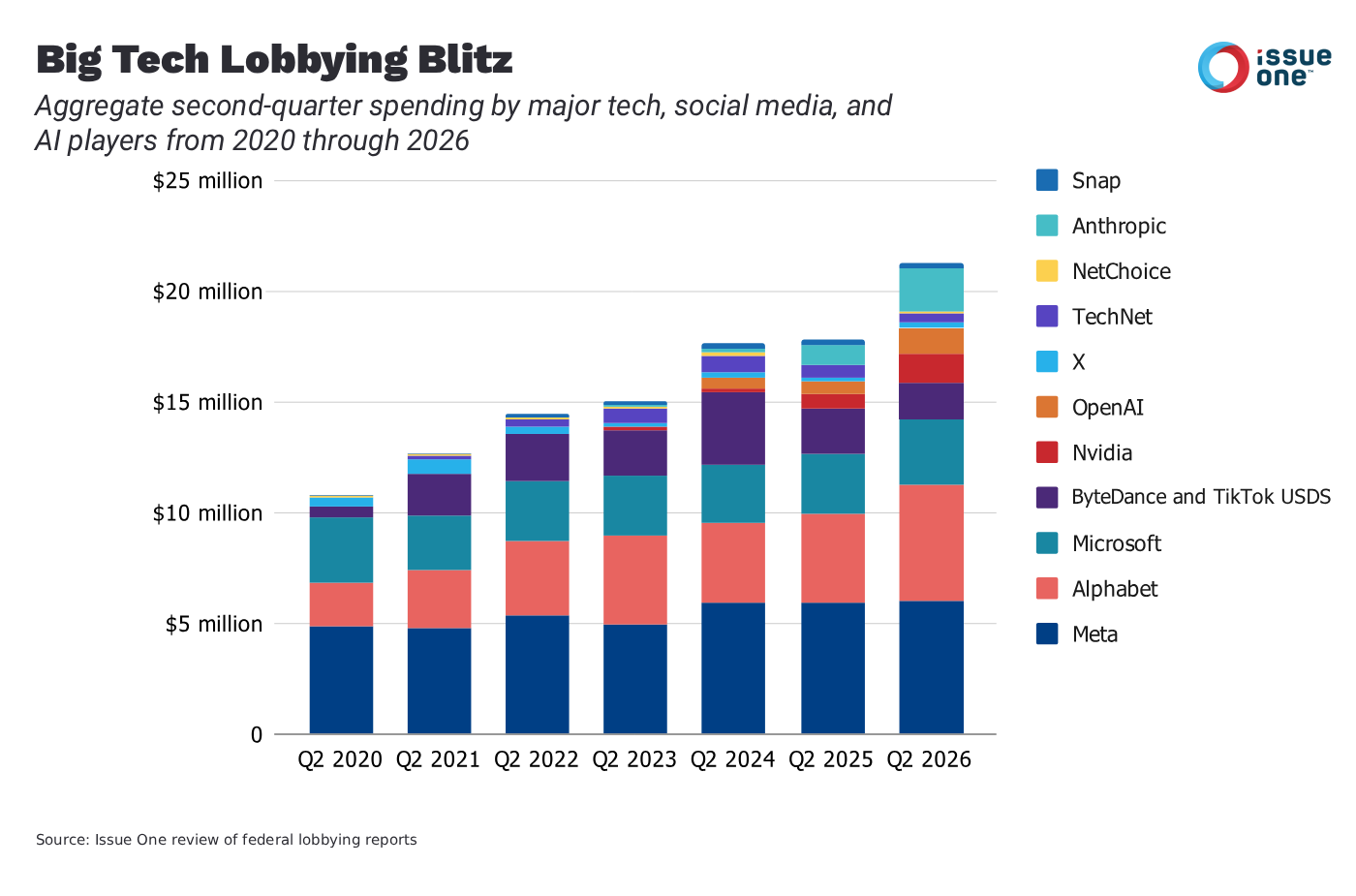
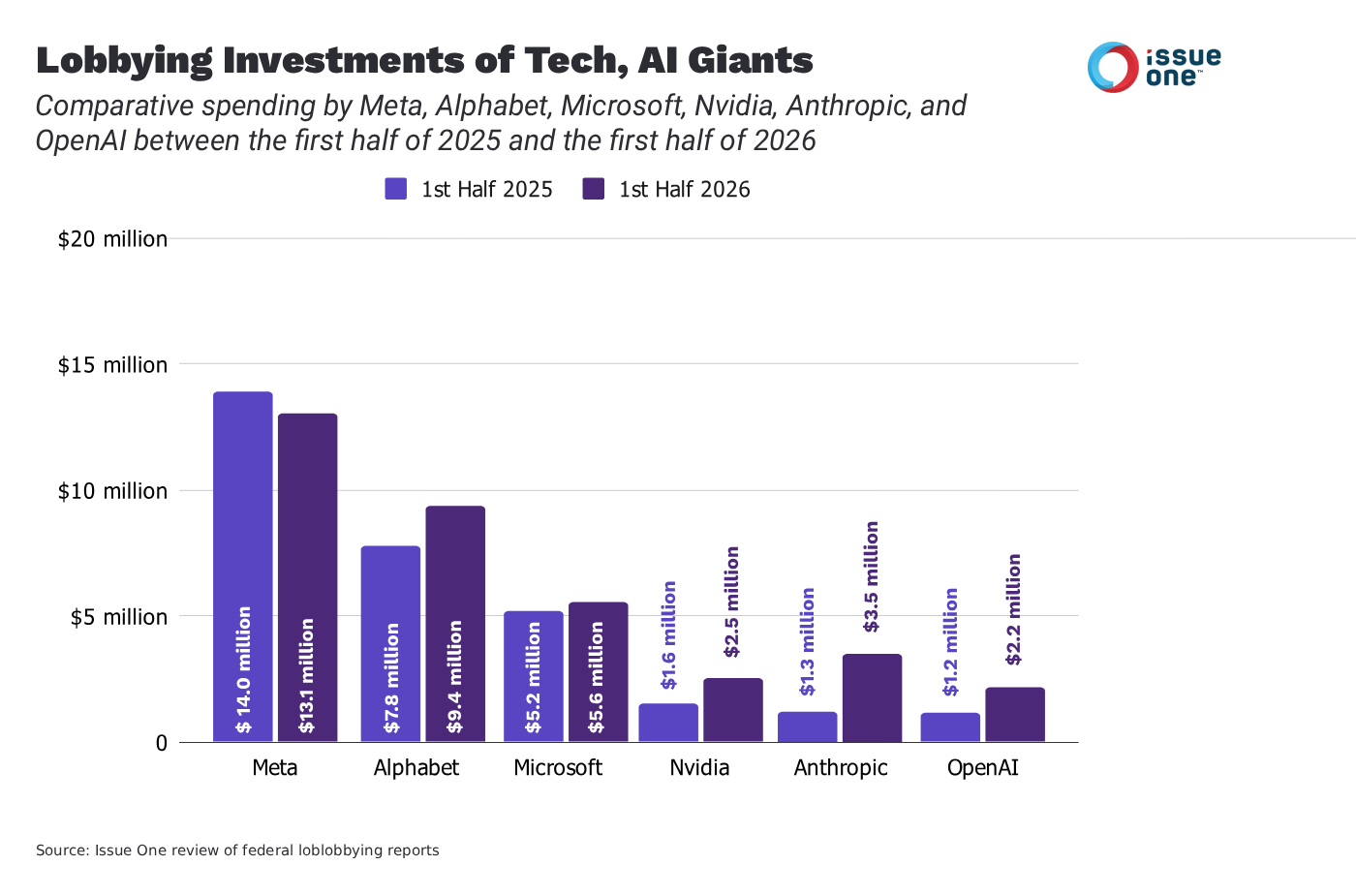
An Issue One review of newly filed lobbying disclosures reveals that 11 of the largest technology, social media, and artificial intelligence (AI) companies, along with their leading trade associations, spent a combined $41.8 million lobbying the federal government between January and June — an average of more than $230,000 per day. That’s up roughly $3.7 million (or 10%) from the $38 million spent by these same entities during the first six months of 2025. And just four years ago, major AI players Anthropic, Nvidia, and OpenAI didn’t even have federal lobbyists.
After pouring millions of dollars into lobbying, campaign spending, and political influence, the tech industry’s wealthiest and most powerful executives are cashing in, securing extraordinary access, and watching the Trump administration bend policy to suit their financial interests. The consequences are existential to every American. While Washington decides the role of artificial intelligence, the protection of children online, and U.S. national security, powerful corporations are buying their way into the room and rewriting the rules to protect themselves above the interests of the American people. Americans deserve a government that operates with transparency and integrity — not one shaped by backroom deals and special access.
Few moments captured the dynamic more starkly than Meta CEO Mark Zuckerberg’s appointment to the White House’s Artificial Intelligence Advisory Council. The announcement came just hours after juries in California and New Mexico found his company negligent and ordered it to pay millions in damages for addicting children. Rather than facing accountability in Washington and in Congress, Zuckerberg was instead delivered a seat at the table and empowered to shape federal AI policy.
He joined Nvidia CEO Jensen Huang, Oracle Executive Chairman Larry Ellison, and Andreessen Horowitz co-founder Marc Andreessen inside the Trump administration’s policymaking apparatus. The appointments gave some of Silicon Valley’s most powerful figures direct influence over federal policy at the precise moment public and congressional scrutiny of the industry has intensified.
This access has also bought protection. The White House intervened to spare Zuckerberg and Alphabet CEO Sundar Pichai, whose companies were found negligent just months earlier, from testifying at a Senate hearing that was scheduled for July 2026, on their child-safety practices and misstatements to Congress in 2024. As a result, the intervention shielded two of the industry’s most prominent executives from public congressional scrutiny.
At the same time, Meta worked behind the scenes to attempt to insert poison pill language into negotiations over the bipartisan Kids Online Safety Act in the Senate, that would have provided their industry total legal immunity for any claims focused on child safety and privacy. The provision aimed to knock out thousands of state and federal lawsuits brought by children and families focused on Big Tech’s role in depression, anxiety, suicide, child sexual abuse, illicit drug trade, trafficking, and more.
Taken together, these episodes amount to more than an aggressive lobbying campaign. They reveal an industry working to entrench itself within the very institutions charged with holding it accountable. Congress and the White House must decide whom they serve: the American people or the tech companies.
Following the Big Tech Money to Lobbyists
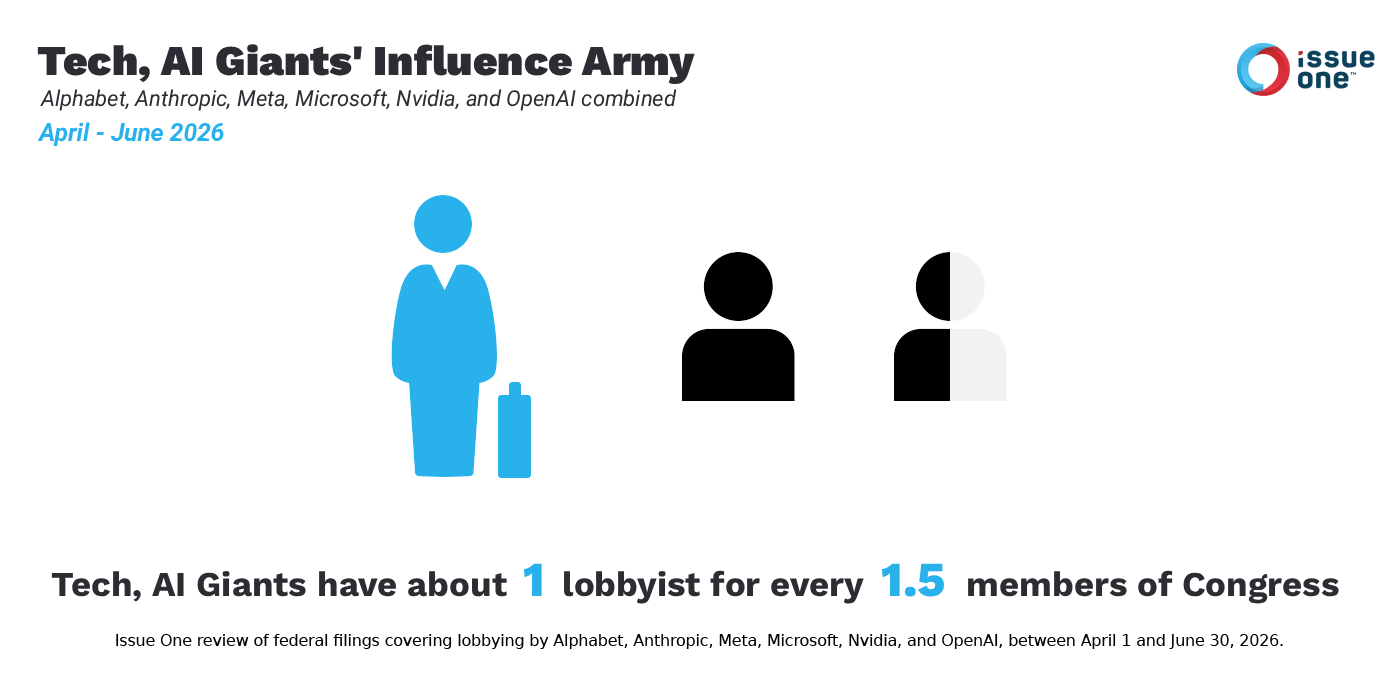
Issue One’s analysis of new federal filings show that six of the biggest tech, social media, and AI companies — Alphabet (the parent company of Google and YouTube), Anthropic (the AI company behind Claude), Meta (the parent company of Facebook and Instagram), Microsoft, AI chipmaker Nvidia, and OpenAI (the AI company behind ChatGPT) — paid for a combined 324 lobbyists during the second quarter of 2026.
That’s the equivalent of approximately 1 lobbyist for every 1.5 members of Congress, and comes as many of those same companies enjoy an unprecedented level of access to the executive branch. This figure includes 31 lobbyists from private lobbying firms representing two or more of these six companies.
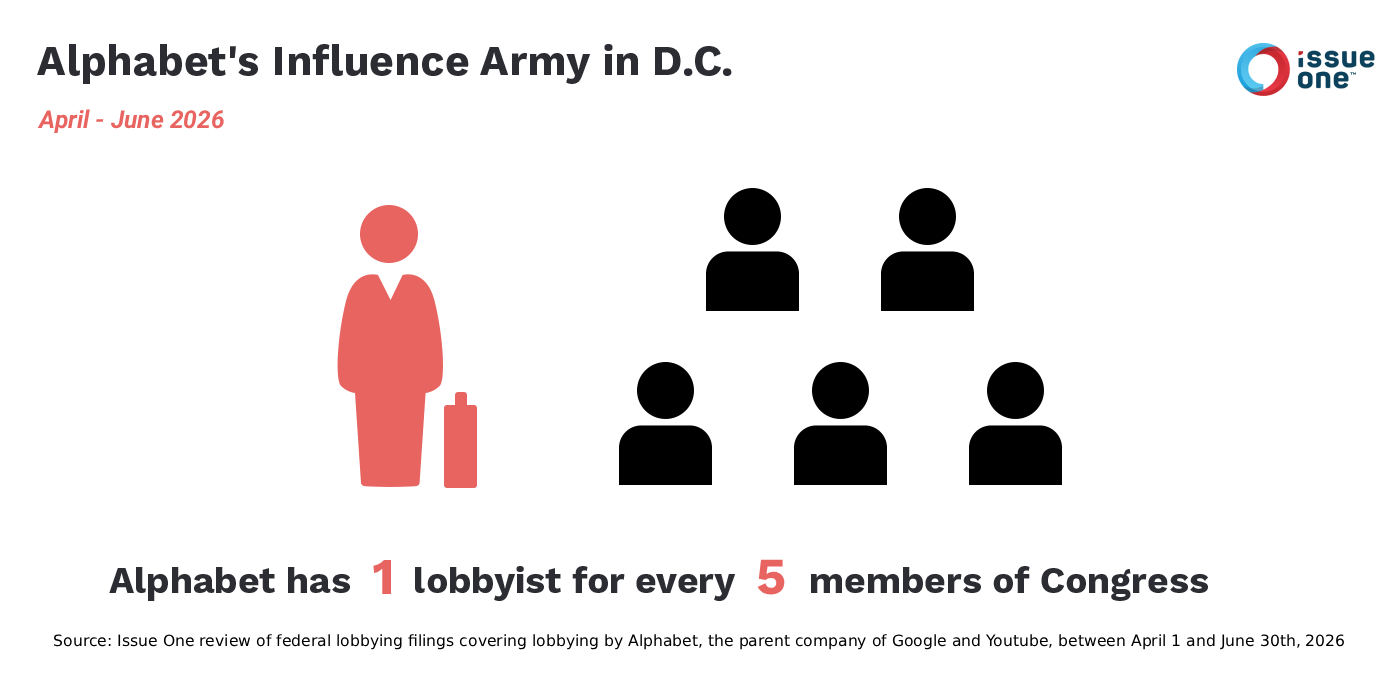
Alphabet alone paid for 111 lobbyists, while Meta paid for 86 — continuing to maintain two of the largest corporate lobbying operations in Washington in the tech sector.
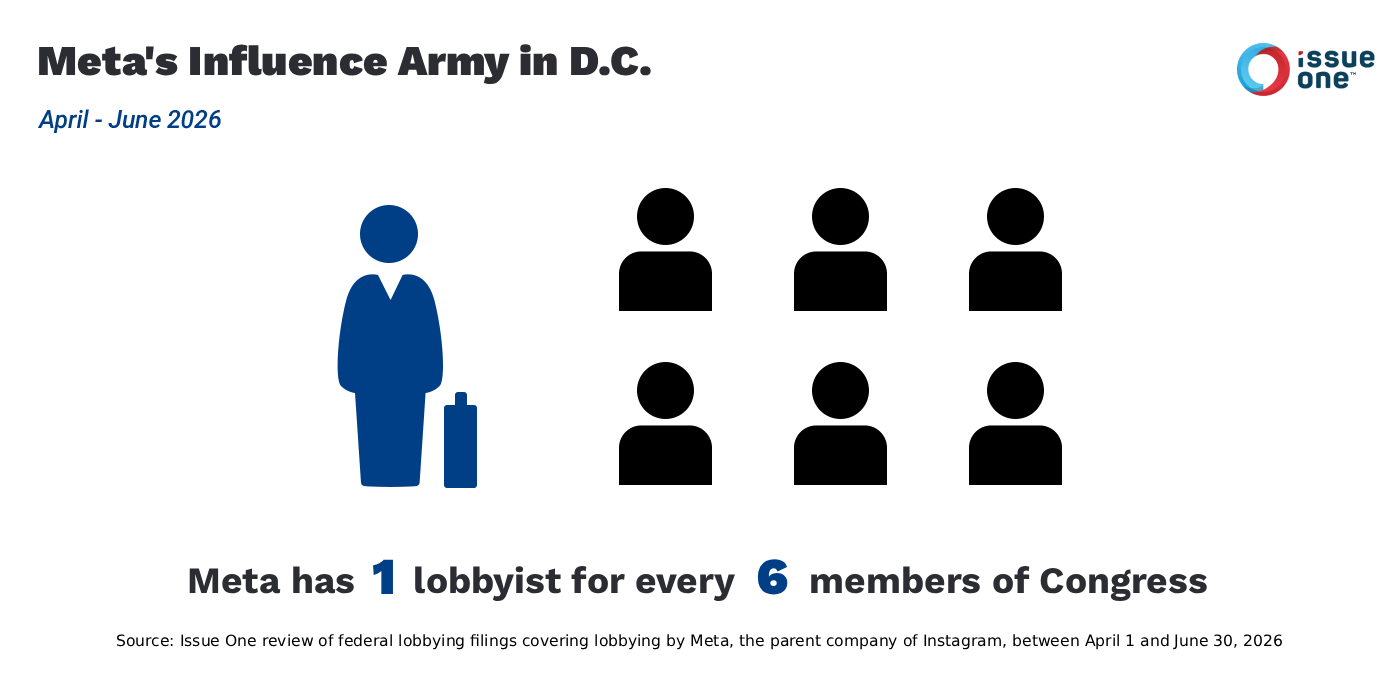
Among these major tech players, Meta reported the largest lobbying expenditures during the second quarter of 2026. Between April and June, Meta spent nearly $6 million on federal lobbying — an average of approximately $66,000 per day.
Meanwhile, Alphabet reported spending $5.3 million on federal lobbying during the second quarter of 2026 , averaging roughly $58,000 per day.
Microsoft reported spending about $3 million between April and June, while Nvidia spent $1.25 million, and OpenAI spent $1.2 million.
Anthropic reported spending a record $1.97 million on lobbying between April and June — more than any other quarter since it first started lobbying in March of 2024. That amounted to an average of roughly $22,000 per day.
Social media companies Snap and X reported lobbying expenditures of $240,000 and $190,000, respectively.
Tech trade associations TechNet and NetChoice also continued their lobbying efforts, spending $440,000 and $60,000, respectively.
ByteDance (the parent company of TikTok) and TikTok USDS Joint Venture LLC (the majority American-owned entity created to avoid the TikTok ban) reported spending $1.88 million lobbying the federal government during the second quarter.